Author

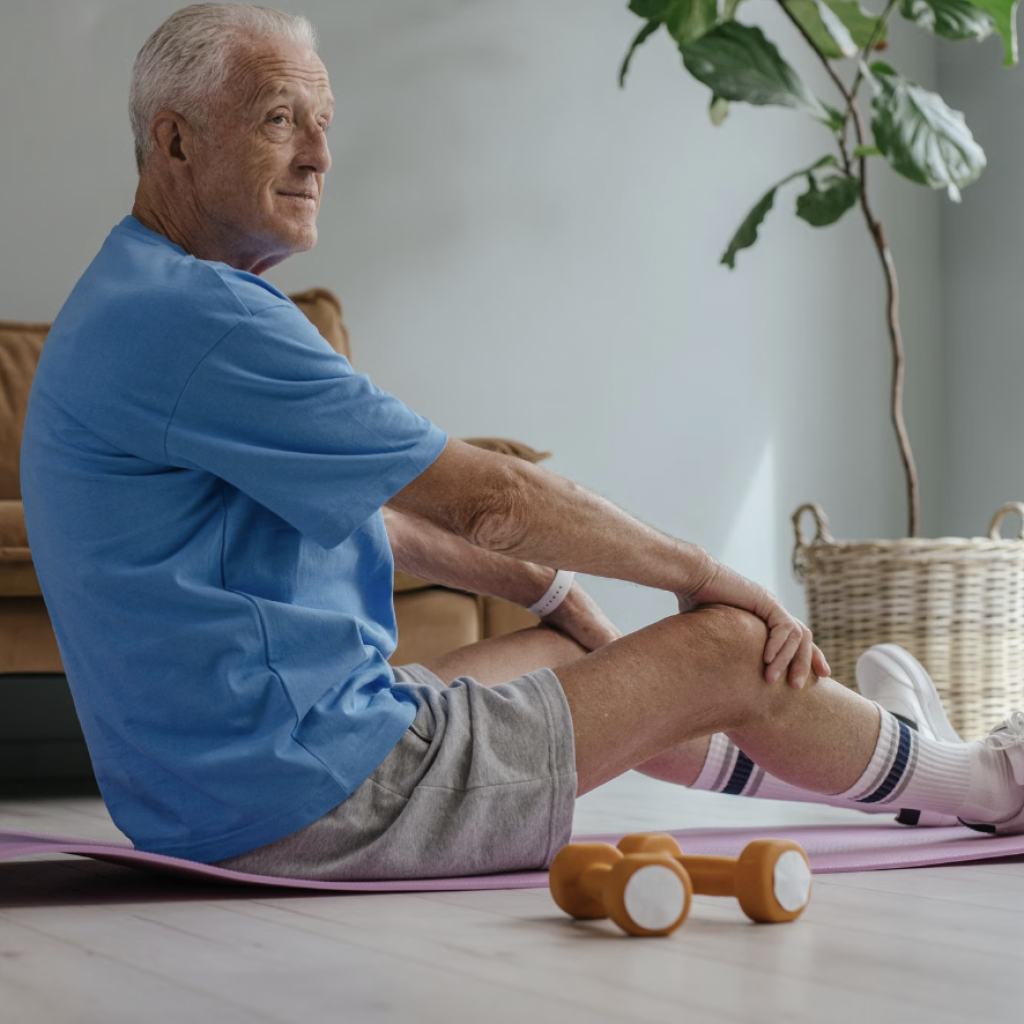
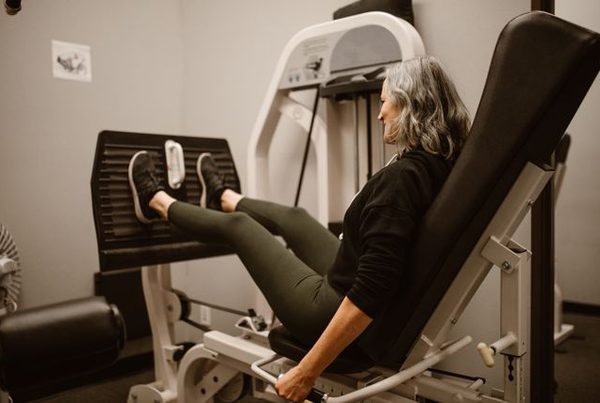
As we age we lose muscle steadily , and it’s the fast, powerful fibres that go first, which are exactly the ones you need to catch yourself when you stumble. By 78 you can be perfectly healthy, walk every day, and still not have enough leg strength to stand up from a low chair without a run-up. Walking doesn’t fix this. Walking is brilliant for plenty of things, but it doesn’t ask your legs to produce much force, so it doesn’t hold onto much strength.
Two things do: resistance training and balance training. Together they’re one of the best-evidenced interventions in the whole of medicine. The programme I used as a starting point is the Otago Exercise Programme, developed in New Zealand – home-based, no equipment, and shown across multiple trials to reduce falls in over-65s by roughly a third.
The Kitchen Counter Programme
A simple at-home strength and balance plan
Three days a week · About 25 minutes · No equipment beyond a chair and a kitchen counter
Before you start
The rules:
- Always have something solid to hold- a kitchen counter, a heavy table, a windowsill. Not a chair that can slide, and not a towel rail.
- Wear proper shoes or go barefoot. Never socks on a hard floor.
- Stop if you feel dizzy, get chest pain, or feel unusually short of breath.
- Aching muscles the next day is normal and fine. Sharp joint pain is not, skip that exercise and come back to it.
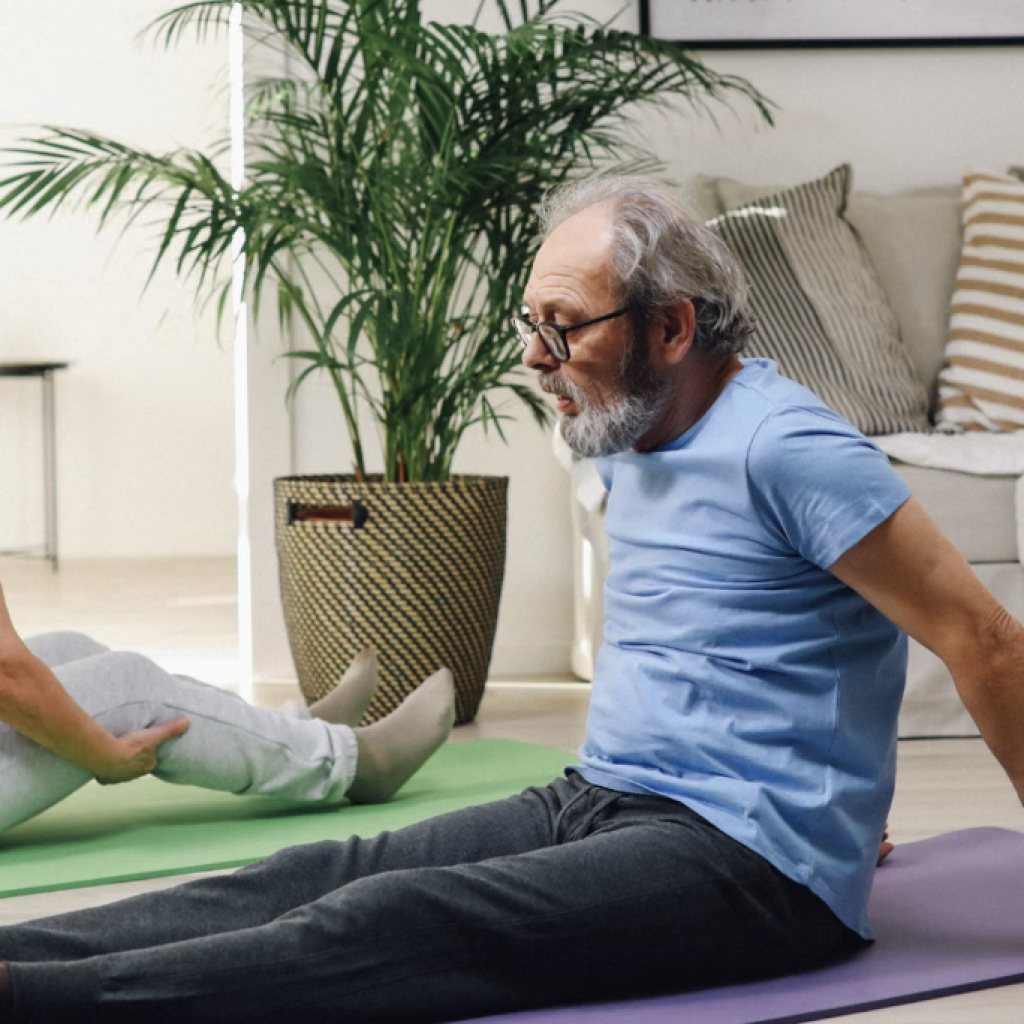
- Doing it together is better than doing it alone. One person spots, one person works.
The week
| Day | What |
| Monday | Full programme |
| Tuesday | Walk |
| Wednesday | Full programme |
| Thursday | Walk |
| Friday | Full programme |
| Saturday | Walk |
| Sunday | Rest |
Walks don’t need to be long. Fifteen to twenty minutes at a pace where you can talk but wouldn’t want to sing. Outdoors is better than a treadmill (uneven ground is balance training in itself.
Warm up (5 minutes)
Do each for about 30 seconds, holding the counter if needed.
- March on the spot – lift the knees to a comfortable height
- Shoulder rolls – 10 backwards, 10 forwards
- Ankle circles – 10 each way, each foot, holding on
- Side-to-side weight shifts – feet hip-width, rock slowly from one foot to the other
- Slow arm reaches – reach up overhead, then out to the sides
Part A (Strength)
Do 2 sets of 10 to begin with. Rest a minute between sets. Move slowly: three seconds up, three seconds down. Slow is the point.
1. Sit-to-stand (the most important one)
Sit near the front of a dining chair, feet flat, slightly back. Lean forward “nose over toes” and stand up. Sit back down under control, don’t drop. Easier: push off the arms of the chair. Harder: arms folded across the chest. Harder still: pause halfway down for two seconds.
2. Heel raises
Hold the counter. Rise onto the balls of both feet, hold for one second, lower slowly.
3. Toe raises
Hold the counter. Keeping heels down, lift the toes and front of the foot up. Lower slowly. This one matters a lot for not catching your feet on things.
4. Mini squat
Hold the counter, feet hip-width. Bend the knees a little no more than a few inches at first, keeping the knees pointing the same way as the toes. Stand back up.
5. Standing side leg lift
Hold the counter. Lift one leg out to the side, keeping it straight and the toes pointing forwards. Lower slowly. 10 each side.
6. Standing knee bend
Hold the counter. Bend one knee to bring the heel up towards your bottom. Lower slowly. 10 each side.
7. Wall press-up
Hands on the wall at shoulder height, feet a step back. Bend the elbows to bring the chest towards the wall, then push away. Harder: step the feet further back.
Part B (Balance)
This is the half that stops falls. Do it every session.
Stand in the corner of the kitchen counter if you can, something to grab on both sides.
1. Feet-together stand
Feet touching side by side. Hold 30 seconds.
2. Heel-to-toe stand
One foot directly in front of the other, heel touching toe. Hold 30 seconds, then swap feet.
3. Heel-to-toe walk
Walk 10 steps along the counter placing each heel directly in front of the other toe. Turn carefully and walk back.
4. One leg stand
Hold on. Lift one foot slightly off the floor. Hold 10 seconds, build to 30. Swap sides.
5. Backward walking
Holding the counter, walk 10 steps backwards, then 10 forwards. Slowly.
How to progress balance work: don’t make it longer, make it less supported.
Level 1- two hands on the counter
Level 2 – one hand
Level 3 – one fingertip
Level 4 – no hands, but hands hovering an inch above
Level 5 – no hands, eyes closed (only for the first two exercises, and only with someone there)
Move up a level when you can hold the full 30 seconds comfortably for a week.
Part C (Getting up off the floor)
Do it on carpet, with someone present, next to a sturdy chair.
- From lying on your back, roll onto your side
- Push up onto your elbow, then your hand, into a sitting position
- Roll onto your hands and knees
- Crawl to the chair
- Put both hands on the seat
- Bring the strongest leg up so that foot is flat on the floor — a half-kneel
- Push up through that leg and your arms, and turn to sit down
Progressing over 12 weeks
| Weeks | Strength | Balance |
| 1–2 | 2 sets of 10, learn the movements | Level 1, 15 seconds |
| 3–4 | 2 sets of 12 | Level 1–2, 30 seconds |
| 5–8 | 3 sets of 12 | Level 2–3 |
| 9–12 | 3 sets of 15, slower tempo | Level 3–4 |
Once 3 sets of 15 feels easy, add a small amount of weight to the leg exercises- a tin of beans in each hand, or a shopping bag with something in it. Then start again at 10 reps.
The honest test of whether it’s working: standing up from a low armchair without using your hands, and walking to the end of the road without thinking about it.
While you’re at it
Fall prevention isn’t only exercise. Ten minutes fixing these is worth a lot:
- Loose rugs and mats – tape them down or remove them
- Trailing cables across walkways
- A lamp or nightlight on the route to the bathroom
- Slippers with backs and grip, not loose ones
- Clutter on the floor in hallways
- A non-slip mat in the bath or shower
- Anything stored so high it needs a stool to reach
Tick sheet
Print this and put it on the fridge. Ticking boxes is unfashionable and it works.
| Week | Mon | Tue | Wed | Thu | Fri | Sat |
| 1 | ||||||
| 2 | ||||||
| 3 | ||||||
| 4 | ||||||
| 5 | ||||||
| 6 | ||||||
| 7 | ||||||
| 8 | ||||||
| 9 | ||||||
| 10 | ||||||
| 11 | ||||||
| 12 |
Based on the Otago Exercise Programme, a home-based strength and balance plan developed in New Zealand and repeatedly shown to reduce falls in adults over 65. Check with a GP before starting, especially if falls, dizziness, or heart problems are already an issue.
If you’d like to start exercising in a small, boutique gym with a personal trainer who can guide your fitness journey and give you a reason to get out of the house and try something new contact us at Sound, Mind and Body.